SAN DIEGO, July 24, 2026 /PRNewswire/ — Jubilant Biosys, an integrated drug discovery and development partner, convened the 2nd EDGE Innovation Forum in San Diego on July 23.
Author: ddAdmin
Analytical Chemistry as a Decision Function: Characterization That Protects Discovery Quality
Analytical Chemistry as a Decision Function: Characterization That Protects Discovery Quality
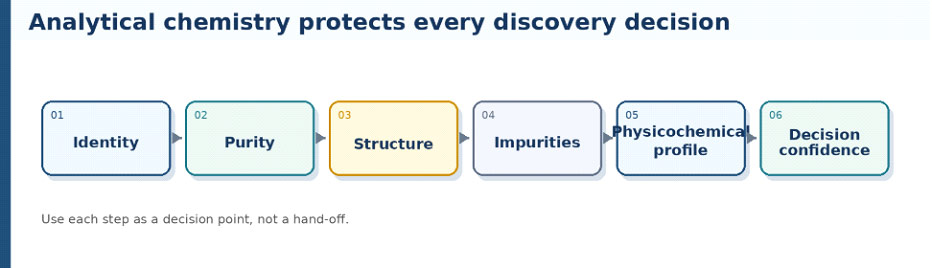
Visual framework: Analytical chemistry protects every discovery decision.
Discovery teams often focus on chemistry and biology output: the number of compounds synthesized, the potency achieved or the speed of the next cycle. But every decision depends on analytical confidence. If compound identity, purity, structure or stability is uncertain, the biological data can be misleading. Analytical chemistry is therefore not a back-end quality check, it is a decision function.
A compound with an incorrect structure, unresolved impurity, poor stability or low purity can distort SAR, create false activity, obscure DMPK interpretation and waste valuable resources. Strong analytical support protects the integrity of discovery data.
Characterization is more than a certificate
For early discovery compounds, identity and purity may be confirmed by LC-MS, NMR, HPLC or related methods. As the programs matures, analytical needs expand to chiral purity, impurity isolation, structure elucidation, physicochemical profiling, , stability, residual solvent analysis and other required method development. Advanced modalities such as oligonucleotides, lipids, PROTACs and ADC payloads may require specialized analytical methods.
Jubilant Biosys provides analytical chemistry support for small molecules and advanced modalities, including chiral and achiral purification, isolation of impurities and metabolites, structure elucidation, NMR, LC-HRMS, FT-IR, UV-visible, solid-state characterization, physicochemical studies, impurity profiling and method development.
Analytical insight prevents misleading SAR
Medicinal chemistry depends on accurate structure activity relationships. If a compound is impure, inactive material may hide true potency or an impurity may create apparent activity. If an analogue epimerizes, decomposes or forms aggregates, the observed biology may not reflect the intended structure. If a chiral compound is tested as an unresolved mixture, the SAR can become confusing.
Analytical scientists help identify these problems at early stage. They can separate and characterize impurities, confirm stereochemistry, evaluate stability, support purification and provide data that makes biological interpretation more reliable.
Analytical chemistry connects discovery to development
As a molecule advances, the analytical role changes. Methods must become more robust, impurity profiles must be understood, solid form must be characterized and the stability must be assessed. Process changes can create new impurities or polymorphic behavior. Analytical development helps define control strategies before scale-up.
This is where integration with PR&D and CDMO capabilities matters. Analytical teams working with synthetic and process chemists can monitor route changes, isolate impurities, develop methods for in-process controls and prepare documentation for technology transfer. The result is a smoother transition from discovery material to development stage.
Data quality is a strategic advantage
Fast discovery is valuable only if the data are trustworthy. Analytical chemistry enables confident decisions by ensuring that the molecule being tested is the molecule the team believes it is. It also helps explain anomalies, protect timelines and reduce the risk of late stage surprises.
For partners working with complex chemistry, advanced modalities or fast-moving lead optimization programs, analytical chemistry should be built into the plan from the start. Better characterization creates better decisions, and better decisions create better candidates.
Talk to Jubilant Biosys about analytical chemistry support for discovery, synthesis, DMPK and development programs. Contact Jubilant Biosys
CADD as a Decision Engine: From Virtual Screening to Designable SAR
CADD as a Decision Engine: From Virtual Screening to Designable SAR
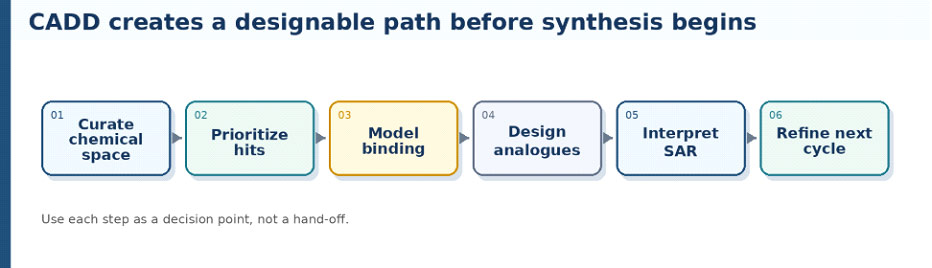
Visual framework: CADD creates a designable path before synthesis begins.
Computational chemistry is sometimes introduced as a way to reduce the number of compounds that need to be synthesized. That is useful, but it is not the full value. The best CADD work creates a better decision system. It helps teams ask which compounds should be made, which hypotheses should be tested and why a particular result changes the next design cycle.
In early discovery, the design space is vast. Chemical libraries, fragment collections, virtual databases and internally accessible building blocks can all produce more ideas than a project can test. CADD brings structure, prioritization and scientific logic to that space.
Virtual screening is only the beginning
Virtual screening can identify starting points, but the quality of the result depends on how the question is framed. A target with a high-quality structure may support docking, scoring and structure-based filtering. A target without a robust structure may need ligand-based approaches, pharmacophore models, QSAR, similarity searching or homology modeling. Fragment-based strategies require different assumptions from lead-like screening. A difficult target class may benefit from chemoinformatics and curated knowledge of related targets.
Jubilant Biosys combines structure-based drug design, ligand-based drug design, pharmacophore and QSAR modeling, homology modeling, docking and scoring, fragment-based design, chemoinformatics and de novo design. This breadth allows the computational strategy to match the target and the maturity of the biology.
The best models are tested, not admired
A model is only valuable if it changes experimental decisions. CADD should propose specific, testable hypotheses: a hydrogen bond to validate, a pocket vector to explore, a lipophilic contact to reduce, a selectivity difference to exploit or a conformational penalty to avoid. Medicinal chemistry then converts those hypotheses into compounds. Assay biology and DMPK test whether the predicted benefit translates into potency, selectivity, permeability, stability or exposure.
This is why computational chemistry is most powerful when integrated into the design-make-test-analyze cycle. A docking pose can explain SAR only if assay data are reliable. A QSAR model can guide substitutions only if the data set is coherent. A virtual screen can produce viable hits only if synthetic feasibility, purity, solubility and property space are considered early.
Chemoinformatics improves prioritization
Modern CADD is increasingly data-driven. Chemoinformatics can support compound library design, diversity analysis, property filtering, scaffold hopping, R-group exploration, reagent enumeration and matched molecular pair analysis. These tools help teams avoid repetitive chemistry and focus on analogues that expand the design space intelligently.
At Jubilant Biosys, computational chemistry teams work with medicinal chemistry, biology, DMPK and structural biology. The availability of curated databases, proprietary tools, commercial platforms, high-performance workstations and integrated chemistry support helps convert in silico ideas into compounds and data quickly.
From prediction to shared understanding
The objective is not to predict every result perfectly. Drug discovery is too complex for that. The objective is to reduce unproductive cycles and strengthen the rationale for each experiment. A well-run CADD program helps teams understand why a compound was selected, what was expected, what actually happened and how the next design should change.
When CADD is treated as a decision engine rather than a stand-alone modeling activity, it becomes a practical accelerator for hit finding, lead optimization and candidate quality.
Talk to Jubilant Biosys computational chemistry specialist about using CADD to sharpen your next DMTA cycle. Contact Jubilant Biosys
Responsible Use of Generative AI in Medicinal Chemistry
Responsible Use of Generative AI in Medicinal Chemistry
A practical framework for helping young scientists improve productivity while safeguarding intellectual property and client confidentiality
Dr. Prasant Deb
Senior Vice President and Site Head, Noida and Greater Noida
Jubilant Biosys
Introduction
Generative AI is rapidly changing how scientists find information, explore ideas and communicate their work. In medicinal chemistry, it can help researchers understand unfamiliar concepts, investigate possible causes of experimental challenges and prepare clearer technical documentation. Yet in a contract research and drug discovery environment, its use must be balanced with an equally important responsibility: protecting intellectual property, client confidentiality and scientific integrity.
Many research organizations are evaluating structured approaches for the responsible use of generative AI in scientific environments. Over the past year, we have led an initiative to help young chemists to use approved generative AI tools effectively and responsibly to improve efficiency and productivity in their work. The objective has never been to replace scientific expertise or judgement. It has been to help scientists learn faster, frame problems more clearly and reduce time spent on routine information gathering and drafting. Scientific conclusions, experimental decisions, client deliverables and research recommendations must always be generated, reviewed and approved by qualified scientists. AI-generated content should never be relied upon as a substitute for scientific judgment.
The foundation of the initiative is simple. Generative AI can support scientific thinking, but confidential science must never be entered into a public or unapproved AI system. This article outlines the practical framework, use cases and lessons that have guided our approach.
Why a structured approach is necessary
Medicinal chemists routinely work across reaction mechanisms, literature analysis, synthetic route planning, analytical interpretation, experimental troubleshooting and technical communication. Young scientists, in particular, may spend considerable time searching for foundational information, comparing methodologies and preparing summaries or presentations.
Generative AI can accelerate some of these activities. It can explain concepts in accessible language, suggest lines of enquiry and help structure technical content. However, unrestricted use can expose sensitive information, including compound structures, unpublished synthetic routes, structure-activity relationship data, experimental observations and client or project identifiers.
Responsible adoption therefore requires more than access to a tool. It requires clear boundaries, practical training and a culture in which every output is treated as a starting point for scientific evaluation, not as an authoritative answer.
The guiding principle
The principle shared with our young chemists is: use generative AI to improve your thinking, not to reveal your science.
Used within appropriate guardrails, generative AI can support scientific learning, literature understanding and general knowledge development including communication. It should never become a repository for confidential information, nor should it make decisions that require scientific accountability. As a rule of thumb, Client-owned information, data, inventions, research findings, compound structures, biological information, analytical results and project-related materials should never be entered into public AI platforms.
A three-part framework for responsible use
1. Protect confidential and proprietary information
Scientists must not enter client details, project identifiers, molecular structures, unpublished data, laboratory notebooks, batch records, proprietary reaction schemes or observations linked to active programmes into public or unapproved AI systems. Training should include realistic examples because individual details that appear harmless can, when combined, reveal a project or compound series. It is also imperative that use of AI tools does not alter ownership of intellectual property, confidentiality obligations or contractual commitments applicable to scientific work.
2. Generalise the scientific question
JUseful guidance can often be obtained without disclosing project-specific information. Instead of asking how to improve the yield of a named compound in a particular project, a scientist could ask: What factors commonly contribute to protodeboronation in a Suzuki coupling, and what general mitigation strategies are reported?
This approach moves the discussion from proprietary chemistry to mechanism, methodology and public-domain knowledge. It preserves confidentiality while still helping the scientist identify relevant variables to investigate.
3. Verify before applying
Generative AI outputs can be incomplete, outdated or incorrect. Every response must therefore be critically reviewed, checked against reliable literature and validated experimentally where relevant. The scientist remains responsible for assessing feasibility, safety, scientific relevance and compliance with established procedures. AI can inform a decision; it cannot own the decision.
Practical applications for young chemists
Reaction troubleshooting
When questions are framed generically, generative AI can help scientists explore possible reasons for low conversion, side-product formation or difficult purification. It may prompt consideration of catalyst choice, solvent effects, reagent quality, moisture sensitivity or competing reaction pathways. These suggestions are hypotheses to investigate, not instructions to follow without review.
Literature understanding and scientific learning
AI tools can help explain reaction mechanisms, compare established synthetic methodologies and provide an initial orientation to unfamiliar technologies. This is particularly useful when scientists encounter areas such as targeted protein degradation, lipid chemistry, peptide synthesis, photoredox chemistry, electrochemistry or flow chemistry. The tool can shorten the path to understanding, but primary literature and trusted databases remain the basis for scientific conclusions.
Technical writing and communication
Generative AI can help organise non-confidential content, improve clarity and adapt technical information for different audiences. Appropriate uses include refining generic experiment summaries, structuring meeting minutes, improving project-update language and developing presentation outlines. Scientists must review the final text for accuracy, context and tone, and must not upload confidential source documents to obtain a draft.
Root cause analysis and planning
For recurring laboratory challenges, AI can support an initial, structured exploration of possible causes, including sensitivity to moisture or oxygen, scale-up variables, mixing, heat transfer, impurity formation and safety considerations. This can broaden the questions considered before the team turns to literature review, experimental design and expert discussion.
Activities that remain outside the boundary
The framework explicitly prohibits uploading or sharing:
- Compound structures or active project chemistry
- Client names, project identifiers or confidential presentations
- Unpublished structure-activity relationship tables or biological data
- Experimental notebooks, raw datasets, spectra or confidential reports
- Proprietary synthetic routes, batch records or process information
- Requests to design chemistry around an active client programme
These boundaries must be reinforced through periodic training, practical examples and alignment with organisational information-security policies. Where there is any doubt, the information should not be entered.
What we have learned
Industry experience suggests, a structured approach may help young chemists become more confident in navigating unfamiliar scientific topics, broaden the range of hypotheses they consider and communicate technical information more clearly. It can also reduce effort in selected routine tasks, particularly early-stage information gathering and the organisation of non-confidential content.
The quality of adoption depends on the quality of training. Simply providing access to an AI tool is insufficient. Scientists need examples of acceptable and unacceptable prompts, a clear escalation route when they are uncertain, and repeated reminders that plausible language is not evidence of scientific accuracy.
Governance is equally important. Approved tools, access controls, organisational policies and human review should be defined before use is scaled. The framework must also evolve as AI capabilities, regulations and information-security expectations change.
Human expertise remains central
Successful chemistry depends on experimental insight, mechanistic understanding, critical thinking, creativity and experience. Generative AI does not reproduce the full context of a laboratory, understand the history of a programme or assume accountability for a scientific decision.
Its value lies in augmenting the scientist. The strongest users are not those who accept outputs quickly, but those who ask better questions, recognise uncertainty, verify claims and apply expert judgement.
Conclusion
Generative AI can be integrated responsibly into chemistry-led research when its role and boundaries are clearly defined. A practical model rests on three disciplines: protect confidential information, generalise scientific questions and verify every output before use. Organizations should ensure that any use of AI tools is consistent with applicable laws, contractual obligations, information-security requirements, intellectual property protections and industry regulations.
With structured training, appropriate governance and continued scientific oversight, these tools can help young chemists learn faster, communicate more effectively and approach problems from a broader perspective without compromising intellectual property, client confidentiality or scientific integrity. The opportunity is not to automate scientific judgement, but to equip scientists to use emerging technology with greater skill and responsibility.
Complex Synthesis That Keeps Discovery Moving: Libraries, Chiral Molecules and Advanced Modalities
Complex Synthesis That Keeps Discovery Moving: Libraries, Chiral Molecules and Advanced Modalities
Discovery programs depend on synthesis that is both creative and practical. A compelling design hypothesis has little value if the molecule cannot be made, purified, characterized and delivered in time to influence the next experiment. Complex synthesis is therefore not a support function. It is a strategic enabler of discovery velocity.
The challenge varies by program. Some teams need rapid analogue synthesis for SAR. Others need focused libraries, chiral compounds, metabolites, reference standards, peptides, carbohydrates, nucleosides, lipids, PROTACs or oligonucleotide-related chemistry. Each requires different synthetic planning and analytical support.
Custom synthesis must balance speed and quality
Fast synthesis should not compromise compound quality. Impurities, incorrect structures, unresolved stereochemistry or unstable products can mislead biology. A good synthetic partner combines route creativity with strong analytical characterization, purification capacity and communication.
Jubilant Biosys offers synthetic chemistry across Noida and Greater Noida facilities with expertise in heterocycles, carbohydrates, peptides, nucleosides, nucleotides, lipids, photo-redox chemistry, organometallics, PROTACs and oligonucleotide synthesis. Capabilities include complex molecules from grams to multikilos, focused libraries, large libraries, metabolite synthesis, scaffold synthesis, flow chemistry and multi-step stereoselective synthesis.
Libraries should answer focused questions
Parallel and library synthesis are powerful when they are designed around clear SAR questions. A focused library can explore vectors, substituent effects, physicochemical space, selectivity hypotheses or metabolic liability fixes. A large library can support broader screening or hit expansion, but only if diversity, quality and assay relevance are considered.
Synthetic teams should work with CADD, medicinal chemistry and assay biology to define the library design. The best libraries are not merely collections of compounds. They are experiments in chemical space.
Chiral and advanced chemistry need analytical discipline
Chirality can strongly influence potency, selectivity, metabolism and safety. Stereoselective synthesis, chiral resolution and chiral analytical methods are essential when stereochemistry matters. Advanced modalities such as PROTACs, lipids and oligonucleotide-related compounds add purification, characterization and stability challenges.
Analytical support is critical. LC-MS, NMR, chiral HPLC, preparative purification, HRMS and specialized methods help ensure that compounds are data-ready. This is particularly important when molecules are high molecular weight, UV-inactive, sensitive or structurally complex.
Synthesis can de-risk development early
Even in discovery, synthetic choices can influence the development path. A route that depends on scarce raw materials, hazardous conditions or chromatographic purification may be acceptable for a few milligrams but problematic later. Early awareness of route scalability helps teams avoid series that are attractive biologically but difficult to advance.
Jubilant Biosys’ integration of synthesis, medicinal chemistry, analytical chemistry, PR&D and CDMO capabilities gives sponsors a route from discovery molecules to larger-scale needs. For fast-moving programs, that continuity can reduce late hand-off risk and keep chemistry aligned with program milestones.
Talk to Jubilant Biosys about synthetic chemistry support for custom molecules, focused libraries and advanced modalities.
The Modern DMTA Cycle: Why MedChem Works Better When Biology, CADD and DMPK Share the Same Clock
The Modern DMTA Cycle: Why MedChem Works Better When Biology, CADD and DMPK Share the Same Clock
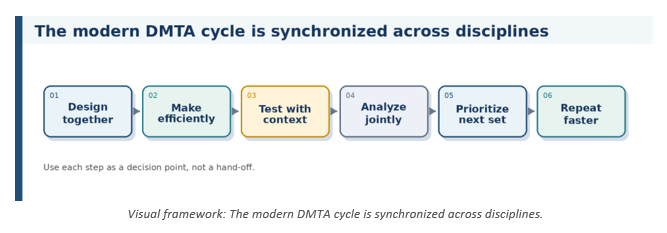
The design–make–test–analyze (DMTA) cycle is the core engine of small molecule drug discovery, but it delivers value only when all components move in sync and data is interpreted collectively. When design is delayed by late DMPK insights, biology outputs lack mechanistic context, or chemistry outpaces data understanding, programs risk being active without gaining insights.
A modern DMTA cycle synchronizes medicinal chemistry, computational chemistry, assay biology, DMPK, analytics and pharmacology. The objective is not merely to turn the crank. It is to make each cycle more informative than the last.
Design should integrate multiple data streams
The design stage should begin with a shared review of the most important data. Which analogues improved potency? Which harmed permeability? Where did metabolic instability appear? Did structural biology confirm the binding pose? Did cellular potency track with biochemical potency? Did a safety signal emerge? Which compounds were hard to synthesize or purify?
When CADD, medicinal chemistry, assay biology, and DMPK evaluate these insights together, the next compound set becomes more targeted, enabling hypothesis-driven design rather than broad, unguided exploration.
Make should be fast but purposeful
Synthetic speed creates value only when aligned with the design intent. Parallel synthesis, library synthesis, scaffold and building-block access, route creativity and analytical support can accelerate compound delivery. However, chemistry teams must avoid generating large numbers of analogues that do not answer the program’s key questions.
Jubilant Biosys supports medicinal chemistry, synthetic chemistry, analytical chemistry and specialized chemistry capabilities across heterocycles, asymmetric chemistry, carbohydrates, nucleosides, nucleotides, peptides, lipids, PROTACs and oligonucleotide synthesis. This breadth helps teams choose chemistry that matches the program need.
Test and analyze should not be separated
Testing should generate interpretable, decision ready data. Potency must be assessed in context of assay conditions, compound quality, solubility, DMPK, permeability, clearance, and structural hypotheses. A less potent compound may still be valuable if it improves exposure or mitigates safety risks, while a highly potent molecule may be unsuitable if it lacks developability.
The analyze stage is critical in the DMTA cycle, where teams interpret outcomes. It should clearly identify which hypotheses hold, which fail, and define the next set of hypotheses to test, ensuring each cycle drives smarter decisions.
Shared cadence creates decision velocity
Coordinated execution across DMTA reduces cycle lag. DMPK automation and high throughput ADME can provide feedback at a cadence aligned with chemistry needs, while assay biology can integrate primary and orthogonal assays to build reliable SAR. CADD continuously refines models with emerging data, and medicinal chemistry prioritizes compounds that address key hypotheses.
When all disciplines operate on a synchronized timeline, programs learn faster—yielding not just more compounds, but a clearer path to candidates with balanced potency, pharmacokinetics, safety, and developability.
Speak with Jubilant Biosys about synchronized DMTA execution across chemistry, biology, CADD and DMPK.
Beyond Binding and Cytotoxicity: Integrated In Vitro Assays for ADC Development

Protein Quality Is Program Quality: Gene-to-Structure Strategies for Better Discovery Decisions
Protein Quality Is Program Quality: Gene-to-Structure Strategies for Better Discovery Decisions
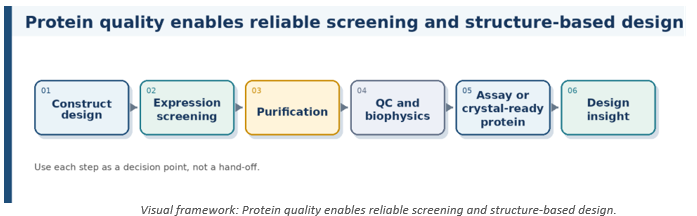
High-quality protein is one of the most important foundations in drug discovery. It affects assay performance, screening reliability, biophysical measurements, crystallography and structure-based design. Poor protein quality can create false negatives, false positives, irreproducible data and misleading SAR. Protein sciences therefore influence the entire discovery trajectory.
For many targets, obtaining suitable protein is not straightforward. Construct boundaries, expression system, solubility, post-translational modifications, cofactors, complexes, purification method and storage conditions can all determine whether the protein is fit for purpose.
Gene-to-protein strategy should match the end use
A protein intended for a biochemical assay may need different characteristics from one intended for crystallography, SPR or fragment screening. Assay protein must be active and stable under assay conditions. SPR protein may require specific immobilization or tagging strategies. Crystallography may require construct engineering, truncations, mutations, complex formation or removal of flexible regions.
Jubilant Biosys provides protein expression and purification services across E. coli, baculo-insect and mammalian systems, along with construct design, expression optimization, scale-up, co-expression, protein complexes, refolding, chromatography purification and protein QC. These capabilities support biochemical and biophysical assays, high-throughput screening and structural studies.
Quality control prevents downstream ambiguity
Protein QC should not be minimal. Purity, identity, intact mass, aggregation state, activity, stability, buffer compatibility and post-translational modifications can all affect the outcome of downstream experiments. Thermal shift assays, mass spectrometry, SDS-PAGE, Western blotting, size exclusion chromatography and biophysical analysis help define whether the protein is suitable for its intended use.
If a screen produces low hit rates or inconsistent data, the problem may be protein quality rather than chemical matter. If a structure cannot be solved, construct design or crystallization strategy may need revision. If SPR binding appears nonspecific, immobilization or protein behavior may be responsible.
Protein sciences strengthen integrated discovery
Protein science is most valuable when connected to assay biology, CADD, medicinal chemistry and structural biology. A protein construct that supports both assay development and crystallography can accelerate the transition from hit finding to structure-based optimization. Protein QC data can explain assay variability. Structural insights can guide medicinal chemistry. SPR kinetics can add mechanistic understanding to potency values.
At Jubilant Biosys, protein sciences and crystallography can be integrated with computational chemistry, medicinal chemistry, assay biology and DMPK. This creates a faster path from target reagent to validated hit and structure-informed lead optimization.
Better reagents create better decisions
In discovery, teams often focus on compounds. But the quality of the target reagent is equally important. Reliable protein enables reliable assays, reliable binding data and reliable structures. That reliability reduces wasted chemistry cycles and strengthens confidence in the program.
A disciplined gene-to-structure strategy helps ensure that the biology the team is testing is real, reproducible and actionable. For challenging targets, that foundation can determine whether the program moves forward or stalls.
Talk to Jubilant Biosys about protein production and structural biology support for your discovery program.