Analytical Chemistry as a Decision Function: Characterization That Protects Discovery Quality
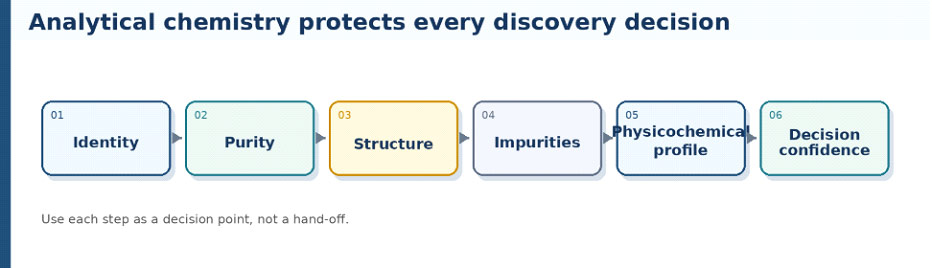
Visual framework: Analytical chemistry protects every discovery decision.
Discovery teams often focus on chemistry and biology output: the number of compounds synthesized, the potency achieved or the speed of the next cycle. But every decision depends on analytical confidence. If compound identity, purity, structure or stability is uncertain, the biological data can be misleading. Analytical chemistry is therefore not a back-end quality check, it is a decision function.
A compound with an incorrect structure, unresolved impurity, poor stability or low purity can distort SAR, create false activity, obscure DMPK interpretation and waste valuable resources. Strong analytical support protects the integrity of discovery data.
Characterization is more than a certificate
For early discovery compounds, identity and purity may be confirmed by LC-MS, NMR, HPLC or related methods. As the programs matures, analytical needs expand to chiral purity, impurity isolation, structure elucidation, physicochemical profiling, , stability, residual solvent analysis and other required method development. Advanced modalities such as oligonucleotides, lipids, PROTACs and ADC payloads may require specialized analytical methods.
Jubilant Biosys provides analytical chemistry support for small molecules and advanced modalities, including chiral and achiral purification, isolation of impurities and metabolites, structure elucidation, NMR, LC-HRMS, FT-IR, UV-visible, solid-state characterization, physicochemical studies, impurity profiling and method development.
Analytical insight prevents misleading SAR
Medicinal chemistry depends on accurate structure activity relationships. If a compound is impure, inactive material may hide true potency or an impurity may create apparent activity. If an analogue epimerizes, decomposes or forms aggregates, the observed biology may not reflect the intended structure. If a chiral compound is tested as an unresolved mixture, the SAR can become confusing.
Analytical scientists help identify these problems at early stage. They can separate and characterize impurities, confirm stereochemistry, evaluate stability, support purification and provide data that makes biological interpretation more reliable.
Analytical chemistry connects discovery to development
As a molecule advances, the analytical role changes. Methods must become more robust, impurity profiles must be understood, solid form must be characterized and the stability must be assessed. Process changes can create new impurities or polymorphic behavior. Analytical development helps define control strategies before scale-up.
This is where integration with PR&D and CDMO capabilities matters. Analytical teams working with synthetic and process chemists can monitor route changes, isolate impurities, develop methods for in-process controls and prepare documentation for technology transfer. The result is a smoother transition from discovery material to development stage.
Data quality is a strategic advantage
Fast discovery is valuable only if the data are trustworthy. Analytical chemistry enables confident decisions by ensuring that the molecule being tested is the molecule the team believes it is. It also helps explain anomalies, protect timelines and reduce the risk of late stage surprises.
For partners working with complex chemistry, advanced modalities or fast-moving lead optimization programs, analytical chemistry should be built into the plan from the start. Better characterization creates better decisions, and better decisions create better candidates.
Talk to Jubilant Biosys about analytical chemistry support for discovery, synthesis, DMPK and development programs. Contact Jubilant Biosys