CADD as a Decision Engine: From Virtual Screening to Designable SAR
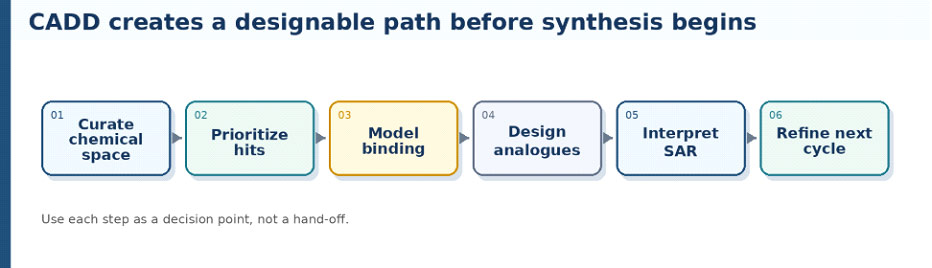
Visual framework: CADD creates a designable path before synthesis begins.
Computational chemistry is sometimes introduced as a way to reduce the number of compounds that need to be synthesized. That is useful, but it is not the full value. The best CADD work creates a better decision system. It helps teams ask which compounds should be made, which hypotheses should be tested and why a particular result changes the next design cycle.
In early discovery, the design space is vast. Chemical libraries, fragment collections, virtual databases and internally accessible building blocks can all produce more ideas than a project can test. CADD brings structure, prioritization and scientific logic to that space.
Virtual screening is only the beginning
Virtual screening can identify starting points, but the quality of the result depends on how the question is framed. A target with a high-quality structure may support docking, scoring and structure-based filtering. A target without a robust structure may need ligand-based approaches, pharmacophore models, QSAR, similarity searching or homology modeling. Fragment-based strategies require different assumptions from lead-like screening. A difficult target class may benefit from chemoinformatics and curated knowledge of related targets.
Jubilant Biosys combines structure-based drug design, ligand-based drug design, pharmacophore and QSAR modeling, homology modeling, docking and scoring, fragment-based design, chemoinformatics and de novo design. This breadth allows the computational strategy to match the target and the maturity of the biology.
The best models are tested, not admired
A model is only valuable if it changes experimental decisions. CADD should propose specific, testable hypotheses: a hydrogen bond to validate, a pocket vector to explore, a lipophilic contact to reduce, a selectivity difference to exploit or a conformational penalty to avoid. Medicinal chemistry then converts those hypotheses into compounds. Assay biology and DMPK test whether the predicted benefit translates into potency, selectivity, permeability, stability or exposure.
This is why computational chemistry is most powerful when integrated into the design-make-test-analyze cycle. A docking pose can explain SAR only if assay data are reliable. A QSAR model can guide substitutions only if the data set is coherent. A virtual screen can produce viable hits only if synthetic feasibility, purity, solubility and property space are considered early.
Chemoinformatics improves prioritization
Modern CADD is increasingly data-driven. Chemoinformatics can support compound library design, diversity analysis, property filtering, scaffold hopping, R-group exploration, reagent enumeration and matched molecular pair analysis. These tools help teams avoid repetitive chemistry and focus on analogues that expand the design space intelligently.
At Jubilant Biosys, computational chemistry teams work with medicinal chemistry, biology, DMPK and structural biology. The availability of curated databases, proprietary tools, commercial platforms, high-performance workstations and integrated chemistry support helps convert in silico ideas into compounds and data quickly.
From prediction to shared understanding
The objective is not to predict every result perfectly. Drug discovery is too complex for that. The objective is to reduce unproductive cycles and strengthen the rationale for each experiment. A well-run CADD program helps teams understand why a compound was selected, what was expected, what actually happened and how the next design should change.
When CADD is treated as a decision engine rather than a stand-alone modeling activity, it becomes a practical accelerator for hit finding, lead optimization and candidate quality.
Talk to Jubilant Biosys computational chemistry specialist about using CADD to sharpen your next DMTA cycle. Contact Jubilant Biosys