Protein Quality Is Program Quality: Gene-to-Structure Strategies for Better Discovery Decisions
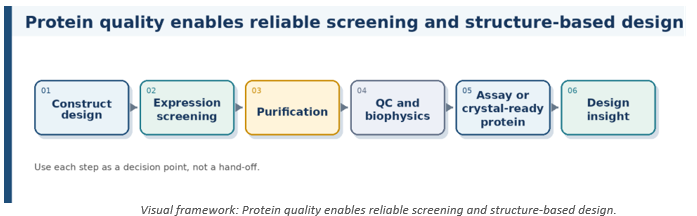
High-quality protein is one of the most important foundations in drug discovery. It affects assay performance, screening reliability, biophysical measurements, crystallography and structure-based design. Poor protein quality can create false negatives, false positives, irreproducible data and misleading SAR. Protein sciences therefore influence the entire discovery trajectory.
For many targets, obtaining suitable protein is not straightforward. Construct boundaries, expression system, solubility, post-translational modifications, cofactors, complexes, purification method and storage conditions can all determine whether the protein is fit for purpose.
Gene-to-protein strategy should match the end use
A protein intended for a biochemical assay may need different characteristics from one intended for crystallography, SPR or fragment screening. Assay protein must be active and stable under assay conditions. SPR protein may require specific immobilization or tagging strategies. Crystallography may require construct engineering, truncations, mutations, complex formation or removal of flexible regions.
Jubilant Biosys provides protein expression and purification services across E. coli, baculo-insect and mammalian systems, along with construct design, expression optimization, scale-up, co-expression, protein complexes, refolding, chromatography purification and protein QC. These capabilities support biochemical and biophysical assays, high-throughput screening and structural studies.
Quality control prevents downstream ambiguity
Protein QC should not be minimal. Purity, identity, intact mass, aggregation state, activity, stability, buffer compatibility and post-translational modifications can all affect the outcome of downstream experiments. Thermal shift assays, mass spectrometry, SDS-PAGE, Western blotting, size exclusion chromatography and biophysical analysis help define whether the protein is suitable for its intended use.
If a screen produces low hit rates or inconsistent data, the problem may be protein quality rather than chemical matter. If a structure cannot be solved, construct design or crystallization strategy may need revision. If SPR binding appears nonspecific, immobilization or protein behavior may be responsible.
Protein sciences strengthen integrated discovery
Protein science is most valuable when connected to assay biology, CADD, medicinal chemistry and structural biology. A protein construct that supports both assay development and crystallography can accelerate the transition from hit finding to structure-based optimization. Protein QC data can explain assay variability. Structural insights can guide medicinal chemistry. SPR kinetics can add mechanistic understanding to potency values.
At Jubilant Biosys, protein sciences and crystallography can be integrated with computational chemistry, medicinal chemistry, assay biology and DMPK. This creates a faster path from target reagent to validated hit and structure-informed lead optimization.
Better reagents create better decisions
In discovery, teams often focus on compounds. But the quality of the target reagent is equally important. Reliable protein enables reliable assays, reliable binding data and reliable structures. That reliability reduces wasted chemistry cycles and strengthens confidence in the program.
A disciplined gene-to-structure strategy helps ensure that the biology the team is testing is real, reproducible and actionable. For challenging targets, that foundation can determine whether the program moves forward or stalls.
Talk to Jubilant Biosys about protein production and structural biology support for your discovery program.